The food industry has a transparency problem. Words like “scratch-made,” “fresh,” “artisan,” and “house-made” are used so loosely and so broadly that they have been drained of almost all meaning. A chain restaurant can advertise “fresh-baked” bread that was mixed in a factory two states away, frozen, shipped, thawed, and finished in an on-site oven. Technically, it was baked on-site. Technically, it is “fresh.” But the gap between that product and genuine scratch-made bread is the Grand Canyon. I think you deserve to know what that gap actually looks like.
This is not an industry exposé or a takedown piece. I am not here to name names or shame competitors. I am here to explain, honestly and in detail, what “scratch-made” means at Dan’s Bagels, what “fresh” means at most chain operations, and why the difference produces a fundamentally different product.
The Chain Model: “Fresh” from a Factory
Most chain bakeries and bagel shops operate on a commissary or par-bake model. Here is how it typically works: dough is mixed and partially baked at a central production facility — often hundreds or thousands of miles from the retail location. The partially baked products are flash-frozen and shipped to stores via refrigerated trucks. At the store level, frozen products are thawed overnight and finished in an on-site oven the next morning. The finished products are placed in display cases and sold as “fresh-baked.”
Legally, this is not deceptive. The product was baked at the location. The sign that says “baked fresh daily” is technically accurate. But the product was not made at the location. The dough was mixed days or weeks ago, in a factory, by machines, using commercial yeast for speed and chemical additives for shelf stability. The “baking” that happens on-site is really just reheating. It is the food equivalent of microwaving a frozen dinner and calling yourself a chef.
What “Scratch-Made” Means at Dan’s Bagels
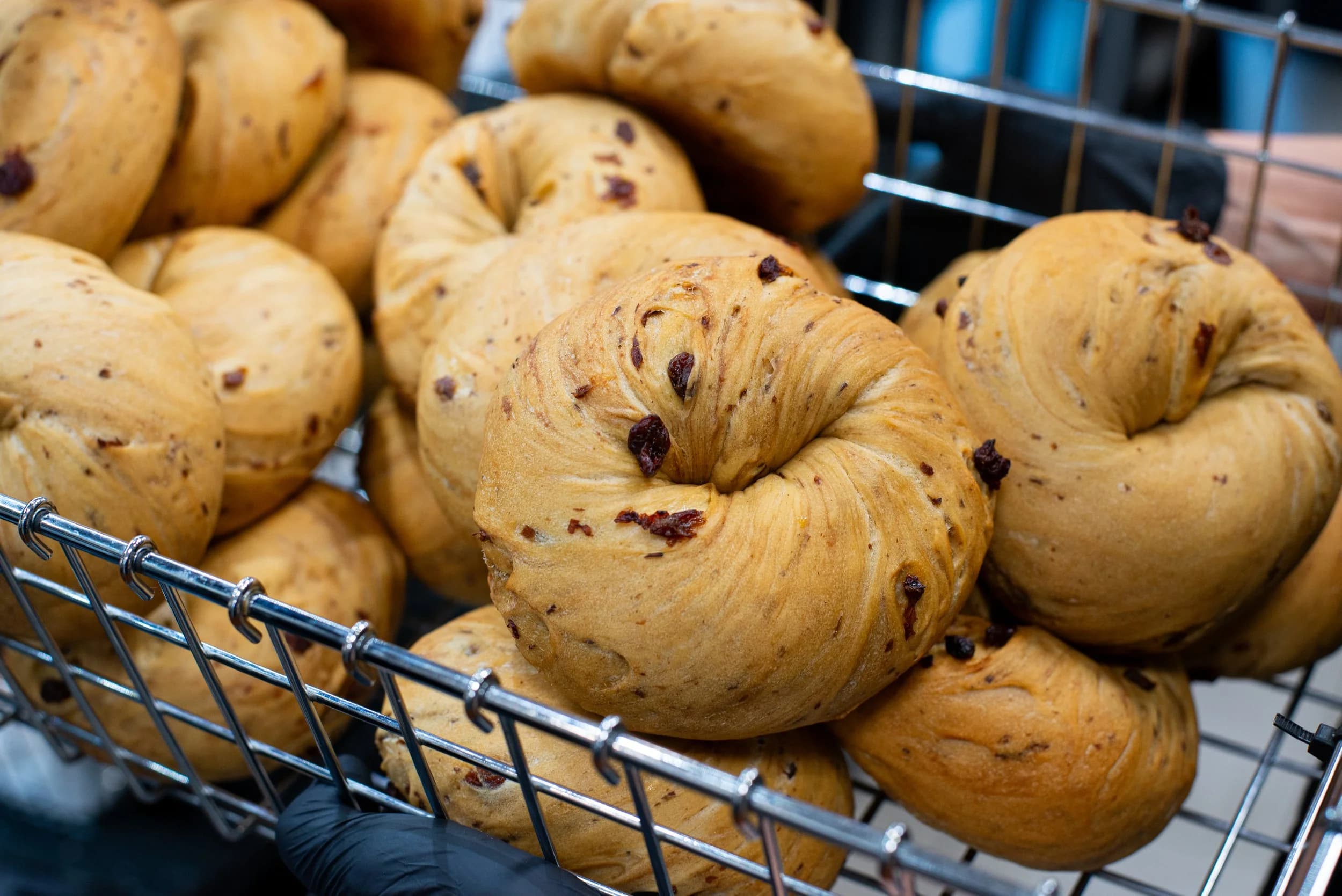
At Dan’s Bagels, scratch-made means exactly what those words imply: we start from scratch. Every single day, in every single location. There is no commissary. There is no central factory. There are no frozen products. There are no par-baked dough rounds shipped in from somewhere else. Our ingredients list is five items: flour, water, sourdough starter, salt, and malt. That is it.
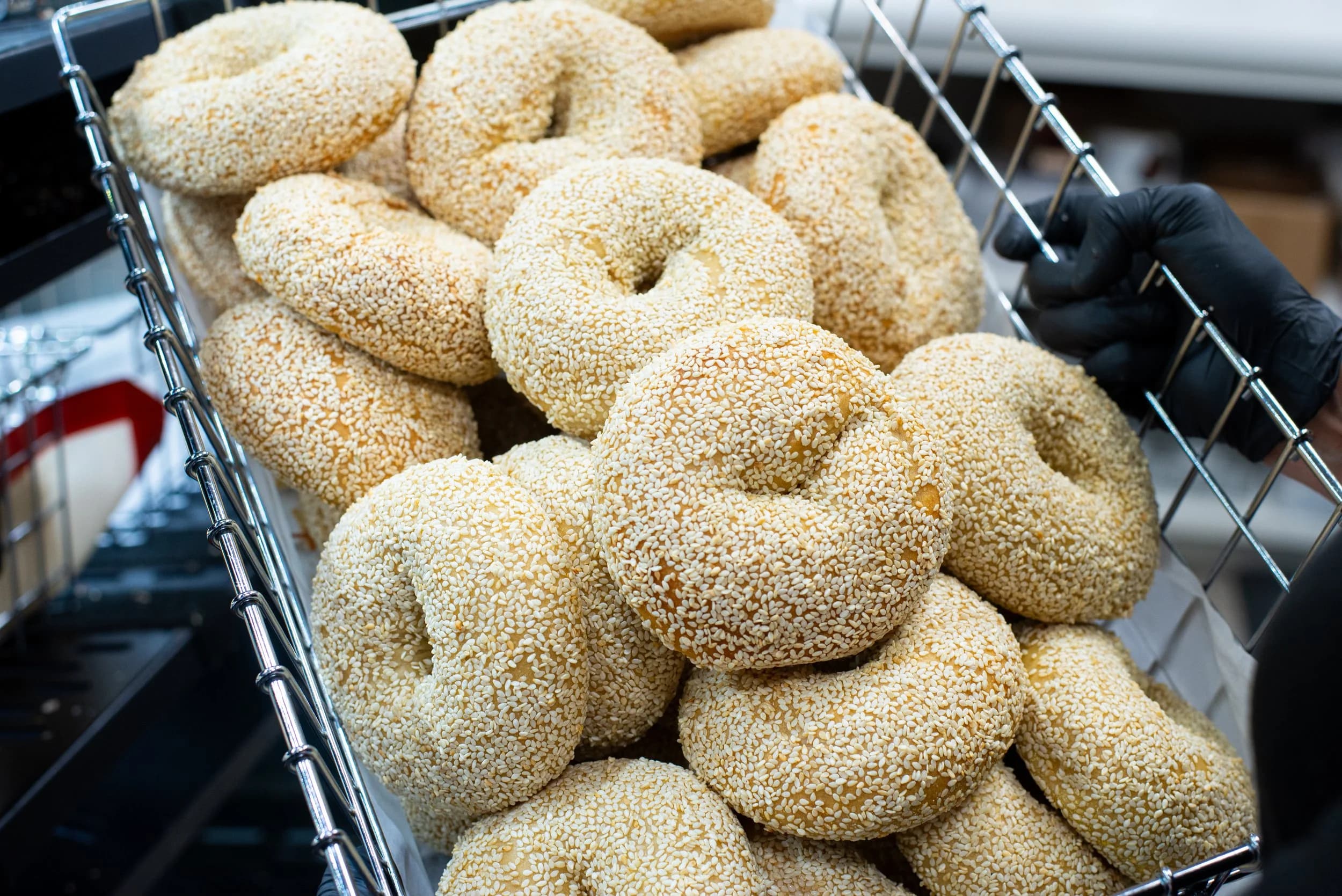
The process begins 48 hours before a bagel reaches your hands. On Day 1, our team mixes the dough using our sourdough starter — a living culture of wild yeast and lactic acid bacteria that we maintain in-house. The mixed dough is placed in our retarder for the first cold fermentation, where it will spend 20–24 hours developing flavor. On Day 2, the dough is pulled, hand-shaped into individual bagels, and returned to the retarder for a second rest. On the morning of Day 3 — starting at 4 AM — the shaped bagels are boiled in malt-sweetened water and baked in our commercial ovens. By 7 AM, the first batch is in the display case.
Every step happens in our kitchen. Every bagel is touched by human hands. Nothing arrives pre-made, frozen, or partially completed. When we say scratch-made, there is no asterisk, no fine print, no creative interpretation of the term.
The 2-Hour Shortcut vs. the 48-Hour Process
The most common shortcut in commercial baking is time compression. A commercial yeast dough can go from mixing bowl to finished product in approximately two hours. The yeast is fast, the rise is quick, the shaping is mechanical, and the bake is immediate. Two hours, start to finish. It is efficient. It is scalable. And it produces a product that is fundamentally different from ours.
In two hours, enzymatic breakdown barely begins. The complex starches and proteins in flour remain largely intact. The Maillard reaction precursors that produce hundreds of flavor compounds during baking never develop. The organic acids that give sourdough its tang and complexity are absent entirely. The gluten network, which needs time to relax and develop, remains tight and unresilient. The result is a bagel that tastes like flour and toppings, with no depth, no complexity, and no lingering flavor.
Our 48-hour process gives time for all of these transformations to occur. The wild yeast and lactic acid bacteria in our starter produce organic acids — lactic and acetic — that create layered tang and depth. Enzymes break down proteins into amino acids and starches into simple sugars, both of which participate in Maillard reactions during baking to produce hundreds of new volatile flavor compounds. The gluten network has time to fully develop and relax, creating the elastic, chewy texture that defines a real bagel. None of this can be rushed. None of this can be faked.
The Cream Cheese Factor
The same transparency applies to our cream cheese program. Jen makes nine flavors from scratch, in our kitchen, using ingredients she sources personally. Most operations — including many that advertise “house-made” flavors — start with a commercial cream cheese base and add flavoring ingredients on-site. The base itself is industrial: stabilizers, thickeners, gums, preservatives. Adding scallions to a commercial base and calling it “house-made scallion cream cheese” is like adding parsley to a can of soup and calling it house-made soup.
Our base is real cream cheese from a dairy we selected for richness and texture. Our add-ins are fresh herbs, real fruits, premium smoked salmon, and carefully sourced ingredients. The result is a product with a texture, freshness, and flavor that commercial bases simply cannot match.
Why Transparency Matters
I am not writing this to make you feel bad about wherever you currently get your bagels. Life is complicated, mornings are busy, and sometimes you grab what is convenient. I get that. But I believe you have the right to know what you are eating and how it was made. When you make a purchasing decision based on words like “scratch-made” and “fresh-baked,” you deserve for those words to mean what they say.
“When we say scratch-made, there is no asterisk. Five ingredients, 48 hours, every bagel touched by human hands. That is what those words mean here.”
At Dan’s Bagels, scratch-made means five ingredients, 48 hours, human hands on every bagel, and a process that has not changed since the day we opened. That is what those words mean here. And you can taste the difference.
Learn more about our 48-hour sourdough process and the science behind it.
Read: The Science of Sourdough