
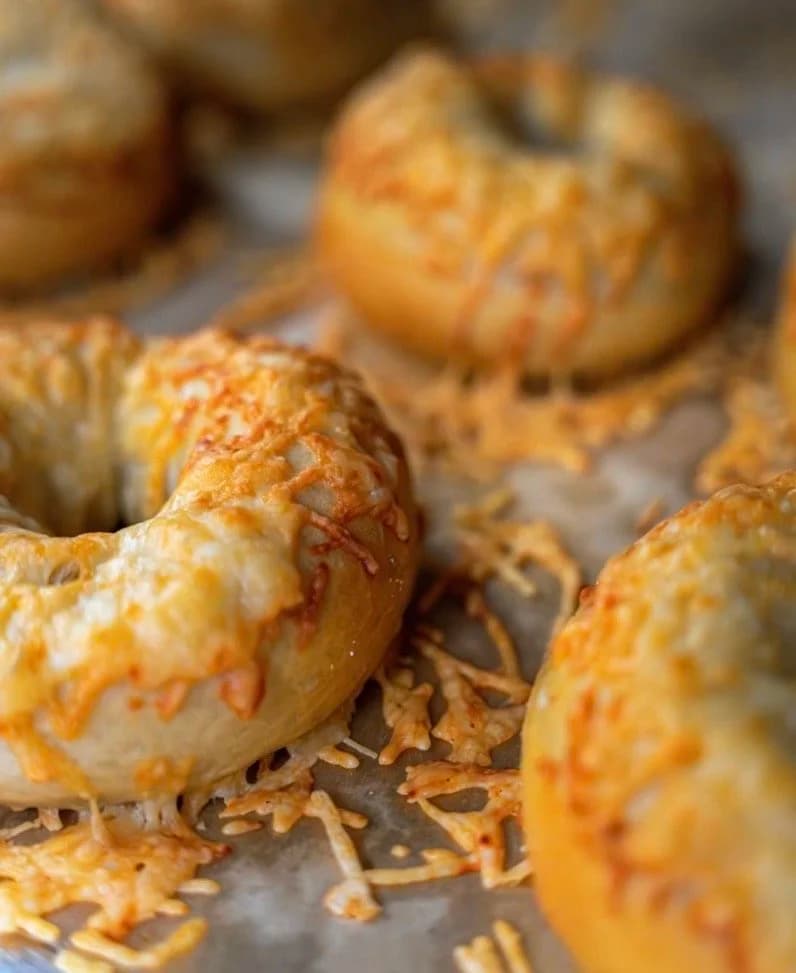
48 Hours.Zero Shortcuts.
A proprietary recipe honed over 2 years of testing. A triple fermentation process that takes 48 hours from dough to oven. A deep dive into our seven-step process — from living sourdough starter to the perfect bagel.
The Living Starter
Sourdough is alive. Dan's starter is over two years old — a stable ecosystem of wild yeast (primarily Saccharomyces species) and lactic acid bacteria (Lactobacillus species). These microorganisms metabolize flour and water through fermentation, producing carbon dioxide (for rise), lactic acid and acetic acid (for tang), and enzymes that transform gluten and starches into something far more complex than their individual parts.
Unlike commercial baker's yeast — a single, fast-acting strain bred for speed — a sourdough starter contains dozens of microbial species working together. Each contributes different metabolites: some produce fruity esters, others peppery phenols, still others the deep umami notes that give sourdough bread its soul. The result is a complexity of flavor that commercial yeast simply cannot replicate.
The starter must be fed — flour and water — and maintained daily. It is a living thing with its own personality. It responds to temperature, humidity, flour type, and the hands of the baker. Skip a feeding, and it weakens. Change the flour, and it adapts over days. Move it to a new kitchen, and it shifts subtly. Bakers develop a relationship with their starters the way musicians develop a relationship with their instruments.
The starter is just the beginning. Our proprietary recipe was honed over 2 years of testing — hundreds of batches, each variable adjusted and re-tested until the result was a bagel we were proud to put our name on. Out of that work came our signature triple fermentation process, a three-stage cold-and-warm fermentation schedule that takes 48 hours from dough to oven. It is the single biggest reason our bagels taste the way they do.
2+
Years old
Dozens
Microbial species
Daily
Feeding required
The 48-Hour Journey
From levain to oven, every step is deliberate. Every shortcut rejected. Here is the complete process, in detail.
Levain Build
A portion of the mature starter is mixed with fresh flour and water to create the levain — the active leavening agent for the day's dough. This builds overnight, developing strong acidity and a rich, complex aroma. The levain must be used at peak ripeness: too young and the dough lacks flavor; too old and the acids weaken the gluten. Timing this step is both science and intuition.
Mixing
High-protein bread flour (14%+ protein for gluten strength), water, barley malt syrup (for sweetness and color), and the ripe levain are combined. The dough is mixed until the gluten network develops — strong enough for the windowpane test, where a thin sheet of dough can be stretched translucent without tearing. This gluten network is the scaffold that gives bagels their characteristic chew. Under-mix it, and the bagel crumbles. Over-mix it, and the texture becomes tough rather than chewy.
Bulk Fermentation
The dough rests in a warm environment while the microorganisms work. Carbon dioxide builds, and the dough rises 30-40%. Flavor compounds develop through enzymatic activity. The dough is folded periodically to build strength and redistribute the yeast. This is where the sourdough culture truly earns its keep — producing the organic acids and aromatic compounds that commercial yeast simply cannot replicate.
Hand Shaping
Each bagel is cut from 110-125 grams of dough. Formed into a tight ball, then poked through the center and shaped into a ring. Every single bagel is shaped by hand — a skill that takes weeks of practice to master. The hole must be wide enough to survive proofing and boiling without closing up. Machine-extruded bagels are uniform, but they lack the subtle variations in density that create interesting texture when you bite through.
Cold Retard
The shaped bagels rest cold in the refrigerator. This slow, cold fermentation is where the real magic happens — more complex organic acids develop, the gluten relaxes, and flavors deepen dramatically. The cold also makes the bagels firmer and easier to handle for the boiling step. This is the patience that separates a real bagel from bread with a hole. Rush this step, and you lose the depth of flavor that defines a great bagel.
The Boil
Every bagel is boiled in malt-sweetened water — barley malt syrup in the boiling water. This gelatinizes the surface starches, creating the signature shiny, chewy crust. The malt adds color and a subtle sweetness. This is THE step that separates a real bagel from bread with a hole. Many shops skip it. Dan's never does. After boiling, toppings are applied while the surface is still tacky — seeds and seasonings embed themselves in the gelatinized layer, which is why they don't fall off.
The Bake
Into a hot oven until deeply golden. The steam from the gelatinized surface creates initial oven spring. The Maillard reaction transforms the crust, producing hundreds of flavor compounds. The exterior develops its characteristic snap — a slight crackle that yields immediately to the dense, chewy crumb inside. The bagels emerge smelling of malt and toasted wheat, best within six hours of baking.
Why 48 Hours Matters
- ×1-2 hour rise with commercial yeast
- ×No flavor development — bland, one-note taste
- ×Soft, uniform texture — more like bread than a bagel
- ×Often skips the boil entirely
- ×Higher phytic acid, harder on digestion
- ✓Proprietary triple fermentation over 48 hours with wild sourdough culture
- ✓Complex tang and sweetness from organic acids
- ✓Crispy-chewy character with dense, satisfying crumb
- ✓Kettle-boiled in malt water — every single bagel
- ✓Better digestibility — fermentation breaks down phytic acid
Long fermentation breaks down phytic acid, improving mineral absorption. It partially degrades gluten, making the bread easier on digestion. And it produces a spectrum of organic acids — lactic, acetic, propionic, butyric — that commercial yeast cannot create. These acids are responsible for the depth of flavor people describe as “malty,” “slightly sweet,” or simply “real.”
You can taste the difference in a single bite. But understanding the why makes you appreciate it on an entirely different level.
The Boil — In Depth
If there is one step that defines a real bagel, it is the boil. This is what separates an authentic bagel from bread shaped like a ring. Here is exactly what happens when a bagel hits the water — and why it matters.
Gelatinize the Surface Starches
The boiling water gelatinizes the starches on the bagel's surface, creating a glossy, chewy shell. This barrier limits oven spring — which is why bagels are dense rather than fluffy. The gelatinized surface also creates a tacky layer that holds toppings in place far better than any egg wash.
Kill Surface Yeast & Set the Crust
The heat of the boiling water kills the yeast on the surface, so the crust sets before the interior during baking. This creates the dense, chewy texture that defines a real bagel. Without the boil, the yeast continues to leaven the surface in the oven, producing a puffy, bread-like exterior.
Malt Caramelization
The barley malt syrup in the boiling water coats the bagel's surface. During baking, this malt caramelizes, producing the gorgeous golden-brown color and adding another layer of subtle, malty sweetness. It's the reason a well-made bagel has that particular shine and depth of color that no amount of egg wash can replicate.
Without the boil, you get a roll, not a bagel.
“Classic NYC ingredients with modern fermentation methods. That's not marketing copy — it's a production commitment that shapes every decision made in our kitchens.”
Continue Exploring
Ready to Taste the Difference?
Now that you know how we make them, come experience the result for yourself. Four DFW locations, open Wed–Sun 7am–1pm.