People ask me all the time why our bagels take 48 hours to make. In a world of two-hour bread recipes and instant everything, it sounds almost absurd. But there's a reason we refuse to rush this process, and it has everything to do with science — specifically, the microbiology of fermentation, the chemistry of flavor, and the physics of what happens when dough meets boiling water.
Let me walk you through what's actually happening inside our dough over those two days, because once you understand the science, you'll never look at a bagel the same way again.
The Living Starter: Wild Yeast and LAB
Every batch of our bagels begins with a sourdough starter — a living culture of wild yeast and lactic acid bacteria (LAB) that we've maintained for years. Unlike commercial yeast, which is a single isolated strain of Saccharomyces cerevisiae bred for speed, our starter contains dozens of wild yeast species and multiple strains of Lactobacillus bacteria. These microorganisms exist in a symbiotic relationship. The wild yeast produces carbon dioxide for leavening, while the LAB produce organic acids that create flavor complexity no commercial yeast can replicate.
This microbial diversity is the foundation of everything. A two-hour bagel uses commercial yeast that produces gas quickly but contributes almost nothing to flavor. Our starter is working slowly, methodically, breaking down complex starches and proteins into the building blocks of taste.
The 48-Hour Fermentation: What Happens and When
Hours 0–4: The Mix and Initial Fermentation
We combine high-gluten flour, water, malt, salt, and our sourdough starter. The dough is mixed until it develops the strong gluten network that gives bagels their signature chew. During the first few hours at room temperature, the wild yeast and bacteria wake up and begin consuming the simple sugars in the flour. Enzyme activity — particularly amylase breaking down starches into sugars and protease softening the gluten network — kicks into gear.
Hours 4–24: The Cold Retard
Here's where the magic happens. We move the dough into our retarder — a refrigerated environment at about 38–40 degrees Fahrenheit. At this temperature, yeast activity slows dramatically, but the LAB keep working. This is critical. The bacteria produce two key acids: lactic acid, which contributes a mild, yogurt-like tanginess, and acetic acid, which adds sharper, more vinegar-like complexity. The slow pace allows these flavors to develop gradually, in layers, rather than arriving all at once.
Meanwhile, enzymatic activity continues to break down proteins and starches. Amino acids released from protein breakdown will later participate in Maillard reactions during baking — those are the browning reactions that create hundreds of new flavor compounds. More amino acids now means a richer, more complex crust later.
Hours 24–36: Shaping and Second Retard
On day two, we pull the dough, hand-shape each bagel, and return them to the cold environment. This second rest further develops flavor and allows the gluten network to relax into its final form. The dough has been slowly fermenting for over a day now. It smells different — tangy, slightly sweet, deeply complex. That smell is flavor waiting to happen.
Why Boiling Matters: Starch Gelatinization
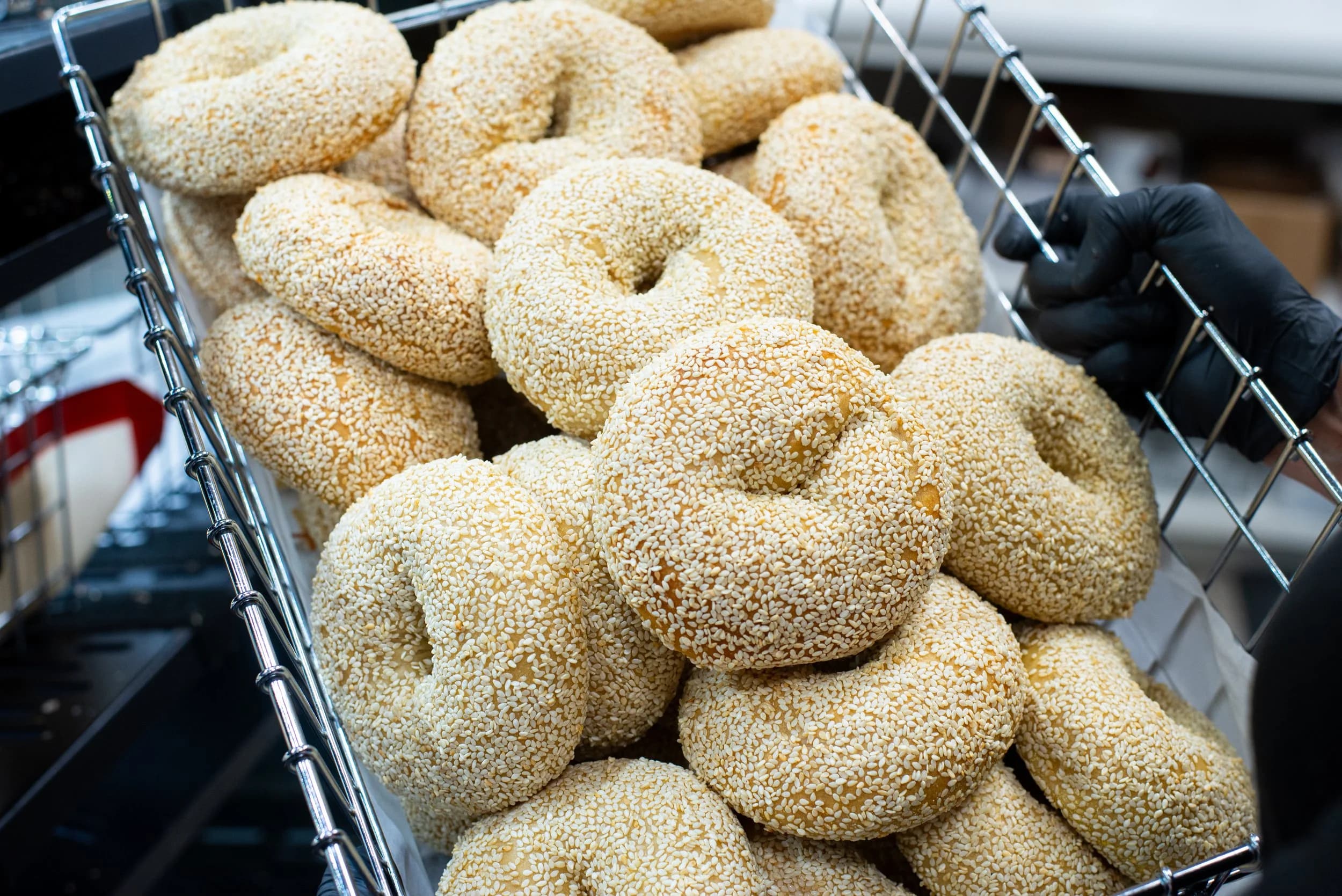
Before baking, every bagel gets a brief swim in malt-sweetened boiling water. This step is non-negotiable, and here's why: when the raw dough surface hits boiling water, the starches on the exterior gelatinize — they absorb water, swell, and form a thin, gel-like coating. This gelatinized layer serves as a barrier. It limits how much the bagel can expand in the oven, which is why real bagels are dense and chewy rather than fluffy like bread. It also sets the stage for the crust — that thin, slightly crackly exterior that shatters when you bite through it.
The malt in the water contributes sugars to the surface, which caramelize during baking to give bagels their characteristic golden-brown shine. Most chain bagel shops skip the boil entirely, using steam injection instead. The result is a bagel-shaped roll — soft, airy, with no chew and no crust. It's a completely different product.
Flavor Chemistry: Why Slow Beats Fast
When our bagels finally hit the 500-degree oven, the accumulated chemistry of 48 hours comes to life. The Maillard reaction between amino acids and reducing sugars produces hundreds of new volatile flavor compounds — nutty, caramel, toasty notes that simply cannot exist in a fast-fermented bagel because the precursor molecules were never created. The organic acids from fermentation contribute complexity and depth. The slow enzymatic breakdown of proteins and starches has created a dough with dramatically more flavor potential than anything made in two hours.
There's also a digestibility benefit. The extended fermentation partially breaks down gluten proteins and phytic acid — a compound in flour that can inhibit mineral absorption. Many customers who report sensitivity to conventional bread find our sourdough bagels much easier on their stomachs. The science supports this: studies have shown that long-fermented sourdough bread has significantly reduced levels of FODMAPs compared to quick-rise bread.
Why We Will Never Rush It
Could we make bagels faster? Of course. We could use commercial yeast and have dough ready in two hours. We could skip the cold retard and go straight to shaping. We could skip the boil and use a steam oven. Many places do exactly that.
But the result would taste different. It would feel different. It would be different. Our 48-hour process isn't a marketing gimmick — it's the minimum time required for the microbiology, the enzyme activity, and the flavor chemistry to do their work. Every hour matters. Every degree of temperature matters. The wild yeast and bacteria in our starter don't care about efficiency or throughput. They care about time, and we give it to them.
“There are no shortcuts to flavor. There are only decisions about how much you're willing to compromise.”
That's why our bagels take 48 hours. And that's why they taste the way they do.
Want to see this process up close? Visit our craft page for photos and video of our bakery in action.
Explore The Craft